Sunday, March 9, 2014

The Enigmatic Symbols of Ancient Egypt, Part IV


The lost symbol of the Sun 

and the Wings of Isis


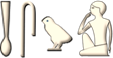
The true identity of this ancient symbol, used to denote the regnal years of the king, has become lost over the years. I know what you are thinking . . . it’s obviously a chocolate chip cookie. Hahaha! Actually, it is thought to be a threshing floor, but I believe this too is incorrect.


This hieroglyphic is used to denote the regnal year. In Ancient Egypt, time was kept by recording the years the pharaohs ruled. A ∩ denotes ten years, while a straight line I indicates one. A rule of twenty eight years would look like this.


It also phonetically represents the sound sp, or, in this case, rnpt-sp (regnal year).


So why is threshing floor an incorrect interpretation? Although the pharaoh was tied to the prosperity of the land, and this does make a connection with the harvest – and, accordingly, the threshing floor – somewhat believable, this symbol is actually associated with time, which IS a designation that the sun and its symbols DO represent.

Take the hieroglyphic phrase for “repeatedly”


or the one for “eternity”


or for “daily course”


“day”


“daytime”


etc, etc, etc. You get the picture. :O)

All of these have two things in common. The sun symbol , Ra, and a reference to time.

Now take the phrase for “a moment”


and “never”


(the arms represent the negative meaning “never will there be a moment”.)

These symbols represent time as well, casting new light upon what this symbol actually is.


Just as Ra is representing one day, I believe the speckled disc in question represents the solar calendar, with each dot representing the years in the lunar cycle.


So why was the meaning behind this disc lost to antiquity? I came across something while researching my book Treasure of Egypt that may answer that puzzling question. Perhaps it was, in part, due to an expungement long ago. Much like the moon’s symbols being misidentified due to religious controversy, it appears as if the speckled disc fell out of favor and was rarely used by the Priests of Amun after the rein of Pharaoh Akhenaten.

If you look, you will find the symbol among many of the writings chiseled into the Telatat blocks from the Aten Temple that was dismantled after the pharaoh’s death. So why was it used so prodigiously during Akhenaten’s reign, yet was almost strictly relegated to denote the regnal year henceforth?

I believe it had much to do with the Heretic King’s closing of the Temples of Amun during his reign and the subsequent efforts of the priests to wipe out the symbols Akhenaten had used to promote his worship of the sun after his death. This once auspicious symbol of the sun has been reduced to what is now thought to be a threshing floor.


The Wings of Isis


There are many sun symbols in the ancient hieroglyphs.


The aten above – a disc with long, streaming rays, the circle with a dot in the middle that represents Ra the sun god, and even Khafre the dung beetle – in a strange association where life springs forth from decay – represent the rebirth of the newly risen sun and the idea of becoming.


It should be noted, however, that the hieroglyphs including the dung beetle are also associated with being or becoming, and not time.

. . . BUT I do not believe that the Wings of Isis is among the symbols that refer to the sun. If you have read my book or the previous articles you know that both Isis and Hathor were associated with rebirth and the moon – not the sun. Another reason that this harvest moon may have been confused with the sun is the moon’s ability to travel across both the day and night skies.

http://www.amazon.com/Treasure-Egypt-adventure-Romantic-Ancients-ebook/dp/B004NSV8JC/ref=sr_1_3?s=digital-text&ie=UTF8&qid=1433949439&sr=1-3&keywords=barbara+ivie+green


Thank you for your readership.
To read the first chapter click here:
 Treasure of Egypt Sneak Peek

To view Treasure of Egypt's Amazon book page and start reading today!
For Amazon.com click here
For Amazon.de click here 
The adventure awaits!


To read the previous articles on The Enigmatic Symbols of Egypt, click below:


The Enigmatic Symbols of Ancient Egypt - Part V


The Unknown Symbol 
Of Ancient Egypt

I love a mystery! A real ancient-world mystery? Even better!

That is why I think the hieroglyphic symbol that symbolically represents sound is so intriguing to me. The image itself has yet to be identified. . . . It is classified as “Unknown”.

“nd”

That’s easy you’re saying—it’s obviously a microphone. LOL!

If this were a modern symbol it may indeed be one, or something radioactive, but the real question is what did this symbol mean to the ancient Egyptians? It looks like a torch.

To better understand what this symbol may be, let us first begin with the triangles surrounding the oval at the top. In several of the hieroglyphs this denotes energy radiating outward.


Heat from a brazier as shown above or light from the sun’s rays as shown below.

“ḫʿ”

If it didn’t represent sound I would think it was a burning torch, but since it does the three triangles coming out of the top of the symbol are obviously meant to be the sound radiating out. The mystery then is what the stick with the oval on top characterizes. Below is the hieroglyph to ask, or inquire.


You may think that the key to this is the person pointing to their mouth, and you would be right.


The hieroglyph above is for eat, speak and emotions, however, this is also used to denote ownership of the verbal action taken.


This is the hieroglyph for voice.


Yet this one is to bequeath.


And this means favor.


To help us get at the answer to this puzzle we need to understand how the ancient Egyptians used body parts to express ideas.

“b”

The foot expressed movement.

“d”

The hand and the arm are used in reference to doing something depending on what it is holding.


If it holding a reed it is for writing, whereas, a loaf of bread signifies an offering, and a stick represents action or even violence.

“r”

The oval is also used as a symbol for a mouth and to infer voice. Keep this shape in mind.


The sideways facing head

”tp” upon or hence.


Literally everything from the hair on top of your head to the bottom of your foot was used. What is not as well-known, however, is the ancient’s use of internal organs to express an idea.

Yes, you read right—internal organs! LOL!

 “imɜḫ” or veneration.
Take the hieroglyph above of cow’s ribs with the issuance or marrow above. 

The ox tongue “ns” overseer.


The heart or “ib”. 

The symbol which sheds the most light on to what may be the true meaning of the symbol for sound is the hieroglyph for “nfr” and represents beauty.


This symbol is the heart and windpipe. Please note the long stick that is used to denote the windpipe.


”nfr” perfect, wonderful, good, beautiful. The horned viper “f” or “nf” and the mouth “r”.


“nfrw” perfection, splendor.

To the ancients the seat of the soul was the heart and therefore was used in this manner to signify beauty. Even Nefertiti, one of the most beautiful queens of Egypt, utilized this symbol in her name repeatedly.


The hieroglyph below is for protect and although we have the hand with the reed implying there is writing involved, such as the type written on the tomb walls that protect the Pharaoh in his journey through the underworld, there is also the symbol for sound. So what is making this noise? Is it an instrument of some type? I believe so.


The most powerful form of protection written on the walls of the tombs was to know and invoke the name of a god or goddess. Much like the ancient Celts the ancient Egyptians also believed that by speaking the name of the deity aloud it summoned them to their aid. Even in the story of Isis gaining the upper hand over Ra, she did so by knowing his real name and using it. Interestingly enough, this scenario plays out rather evenly across the ancient mythologies of the world.

So what musical instrument is being used?
I propose that the oval depicts an open mouth and the stem a windpipe (much like the one in beauty) which has sound issuing forth. I believe it’s the human voice. Music, singing, or a spell chanted was clearly a powerful tool to the ancient peoples of all lands. Either that, or it's and ancient weapon which emits high-frequency waves, using sound as a powerful blast. . . but that would be in a different story. LOL!

http://www.amazon.com/Treasure-Egypt-adventure-Romantic-Ancients-ebook/dp/B004NSV8JC/ref=sr_1_3?s=digital-text&ie=UTF8&qid=1433949439&sr=1-3&keywords=barbara+ivie+green

Thank you for your readership.
To view Treasure of Egypt's Amazon book page and start reading today!
For Amazon.com click here
For Amazon.de click here 
The adventure awaits!

To read the previous articles on The Enigmatic Symbols of Egypt, click below:


Website: www.barbaraiviegreen.com

Facebook: http://www.facebook.com/barbaraiviegreen

Email: barbaraiviegreen@aol.com